
CERVAVAC: Evidence, WHO Prequalification & Vaccine Policy
India’s first indigenous HPV vaccine, CERVAVAC, receiving WHO prequalification marks an important milestone in preventive oncology.
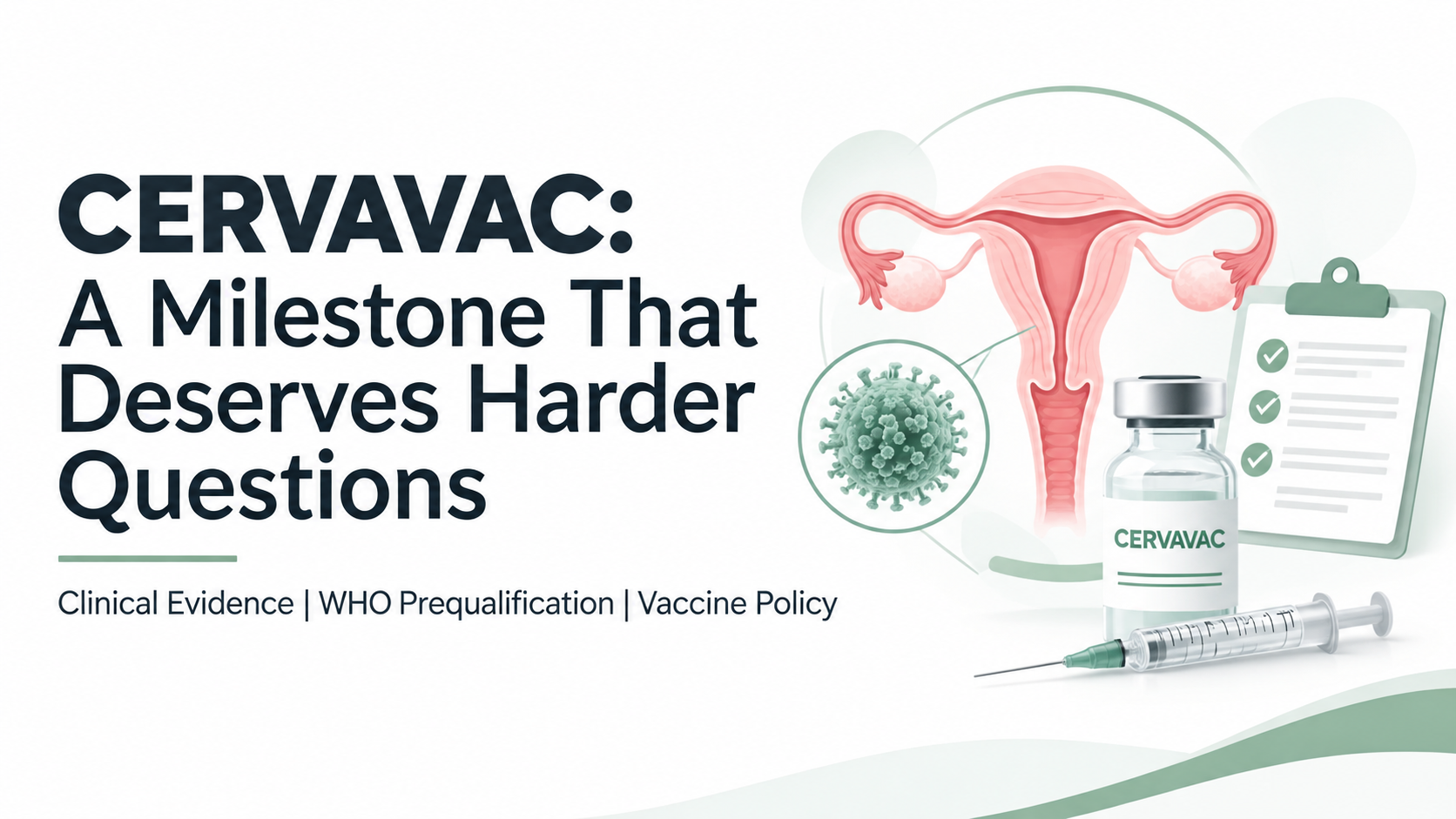
India’s first indigenous HPV vaccine, CERVAVAC, receiving WHO prequalification marks an important milestone in preventive oncology. However, the decision also raises questions about the clinical evidence supporting its approval, the role of immunobridging in establishing vaccine efficacy, and the transparency of the assessment process. Understanding what WHO prequalification confirms—and what remains unestablished—is essential for clinicians, policymakers, and public health professionals evaluating its role in cervical cancer prevention.
Licensed Without a Disease Endpoint
CERVAVAC was approved in 2022 on immunobridging — antibody titres comparable to the established quadrivalent vaccine, measured by a binding assay in arbitrary units, not calibrated to the WHO International Standard. No controlled clinical endpoint — CIN2+, AIS, or cancer — has ever been demonstrated, in any population. The male indication rests on an open-label arm with no comparator. The WHO-prequalified label adds month-24 seroconversion and an uncontrolled 36-month persistent-infection observation, but still no histological endpoint; the protective antibody threshold remains “not established.”
What WHO Prequalification Actually Means
PQ is not a fresh efficacy verdict. It assures manufacturing quality, GMP and batch consistency, and opens UN/Gavi procurement. Crucially, the transparency instrument is the WHOPAR — the WHO Public Assessment Report — the document that sets out what clinical and non-clinical data WHO assessed and why it accepted them (the WHO equivalent of an EMA EPAR or an FDA review). For CERVAVAC, the extranet product page carries only the Product Insert (FVP-P-485-486, Rev. 05/2025). No WHOPAR has been published. That absence is itself the finding: the clinical basis of a global procurement decision is not in the public domain and cannot be externally scrutinised.
Two Ceilings We Cannot Vaccinate Past
The quadrivalent covers HPV 16/18 — 60% of Indian cervical cancers — as the world moves to nonavalent. (Might accounts to almost 20% burden) which no vaccine prevents and which presents later and more aggressively. Vaccination cannot replace screening — which India largely lacks.
A Structural Conflict
The vaccine’s funders, its evaluating collaboration, the body that prequalified it, and the agencies that procure it overlap substantially at the institutional level. Neither the expert committee’s membership and conflict-of-interest declarations nor a WHO assessment report are public. That is a governance gap, not an allegation against any individual.
Consult Dr. Sujata Mittal for Expert Guidance on Cervical Cancer Screening
Keep reading
View all → Cancer Awareness
Breast Cancer & Liquid Biopsy in Rohini, Delhi
Breast cancer is not always limited to the breast. Cancer cells can spread through the blood and lymphatic system, making systemic treatment essential for reducing the risk of recu…
 Cancer Awareness
Targeted Therapy for Breast Cancer: Latest Treatments
Targeted therapy for breast cancer is a modern treatment approach that focuses on specific proteins, genes, or molecular changes that help cancer cells grow and spread.
 Breast Cancer
Breast Cancer Worldwide: Rates, Risks & Treatment Evolution
Breast cancer is now the most common cancer in women, with 2.3 million diagnoses in 2022. See which countries are hit hardest, why India records the most deaths, and how treatment has changed.