
Cervical Cancer in India: A Preventable Tragedy We Keep Choosing to Ignore
What is cervical cancer? A disease where abnormal cells in the cervix—the lower, narrow opening that connects the vagina to the uterus—begin to grow out of control.

What is cervical cancer? A disease where abnormal cells in the cervix—the lower, narrow opening that connects the vagina to the uterus—begin to grow out of control. Not from a rare, untreatable malignancy. Not from a cancer we don't understand. From a disease that is almost entirely preventable — one we can screen for, vaccinate against, and treat effectively when caught early. And yet, India continues to carry one of the heaviest cervical cancer burdens on the planet. The tragedy is not medical. It is political, structural, and deeply indifferent.
The Numbers That Should Shame Us
India recorded approximately 1,27,526 new cervical cancer cases and 79,906 deaths in 2022 alone. We contribute over 65% of the Southeast Asian region's cervical cancer burden, and despite being the world's fifth-largest economy, we rank fourth globally in both new cases and deaths from this disease. Projections are worse: deaths from cervical cancer in India are estimated to rise by 61% by 2040 if the current trajectory continues. The national screening coverage tells its own grim story. Only 1.9% of women aged 30–49 have ever been screened — a figure that is not just low, it is a public health catastrophe in a country of 1.4 billion people.
Which States Bear the Worst Burden?
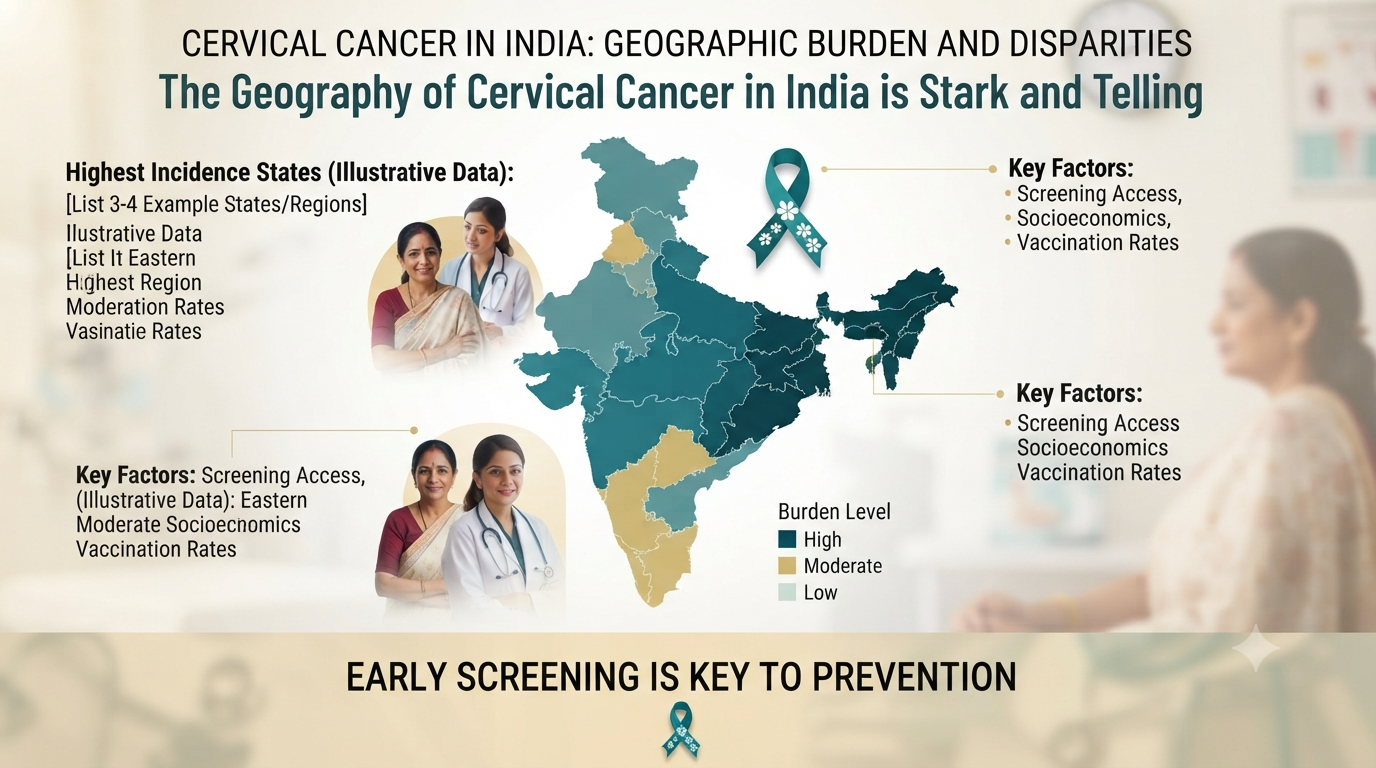
The geography of cervical cancer in India is stark and telling. The Northeast region carries the highest burden, with age-standardised DALYs of 290.1 per 1,00,000 women — nearly double that of the eastern region. Assam has earned the grim distinction of being called the "cancer capital of India." Cervical cancer accounts for 15.4% of all female cancers in the state. The Papum Pare district of Arunachal Pradesh has the highest age-adjusted rate (AAR) for cervical cancer in all of Asia — 27.7 per 1,00,000 women. Mizoram, Manipur, and Sikkim report disproportionately high incidence rates relative to their populations. Significantly, in these states a rising trend in incidence has been noted. Tamil Nadu, paradoxically, ranks first in incidence on the age-standardised scale among larger states, and also leads in cervical cancer deaths — at 12.5 per 1,00,000 women — despite having the country's highest screening coverage of 9.8%. This tells us that screening alone, without functional referral pathways and colposcopy access, saves few lives. Large states like Uttar Pradesh, Maharashtra, and West Bengal contribute the highest absolute case numbers simply by virtue of population size.
The Risk Factors — And India's Unique Vulnerabilities

HPV (Human Papillomavirus) infection — particularly high-risk strains 16 and 18 — is the cause of over 95% of cervical cancers. Early marriage, multiple pregnancies, poor genital hygiene, tobacco use, low immunity, and lack of screening are co-factors. In India, tribal and rural populations carry a disproportionate HPV prevalence, compounding the risk. But the biggest risk factor in India is not biological. It is geography. It is poverty. It is neglect. The Crumbling Infrastructure at the District Level Primary Health Centres (PHCs) and Community Health Centres (CHCs) are supposed to be the backbone of India's rural healthcare. In practice, they are hollowed-out shells when it comes to cancer care. A 2024 cross-sectional study from Pondicherry found that while Visual Inspection with Acetic Acid (VIA) was available in all 15 PHCs examined, more advanced diagnostics — cytology, HPV testing, colposcopy, LEEP (Loop Electrosurgical Excision Procedure), and histopathology — were almost universally absent. Only one PHC had a person trained in cytology processing. None had anyone trained for HPV test processing. This is not a Pondicherry problem. This is India. Most rural women who receive a VIA-positive result are told to "go to the district hospital" or "visit a city." For a woman from a remote village in Assam or Arunachal Pradesh, that journey is not a bus ride. It is a multi-day ordeal — across broken roads, across rivers, across a system that was never designed with her survival in mind. In Tamil Nadu — India's best performer in screening — 41% of VIA-positive women still failed to attend colposcopy follow-up. If this is happening in Tamil Nadu, we can only imagine the situation in Chhattisgarh, Jharkhand, or the hill districts of Meghalaya.
The Absent Gynaecologist
There is a grotesque irony in how India trains specialists. We produce oncologists and gynaecologists in large numbers — but they cluster overwhelmingly in metropolitan centres, private hospitals, and teaching institutions. The trained gynaecologist at the district hospital is increasingly a myth. Many district women's hospitals function without a single full-time obstetrician-gynaecologist, let alone a colposcopist or gynaecologic oncologist. Colposcopy — the gold-standard diagnostic bridge between a positive screen and a confirmed cancer diagnosis — requires training, equipment, and follow-up infrastructure. In India, access to colposcopy remains extremely limited even at secondary care level. Women referred for colposcopy either cannot travel, cannot afford it, or arrive at facilities that do not have a functioning colposcope or a doctor trained to use one. The road — literal and metaphorical — between a positive screen result and a life-saving treatment is broken at multiple points. The Political Will That Never Arrived Here is the most damning truth: despite India's alarming cervical cancer burden, no state in the northeast — the hardest-hit region in the country — has a specific, government-initiated programme for cervical cancer elimination. What exists is a thin overlay of "umbrella" initiatives under the National Programme for Cancer, Diabetes, Cardiovascular Diseases and Stroke (NPCDCS), which treats cervical cancer as one item on a long checklist rather than an emergency. India adopted Visual Inspection with Acetic Acid as its primary screening method in 2016. Yet cervical cancer death rates continued to rise between 2016 and 2019. The government launched a national HPV vaccination programme — and then stalled, reversed, and re-launched it over years of controversy and litigation. Awareness campaigns exist on paper. Screening targets exist in reports. Women continue to die. The implementation gap between policy and ground reality in India's cervical cancer response is not an oversight — it is a policy choice. When you underfund district hospitals, leave gynaecologist posts vacant for years, skip road connectivity to tribal hamlets, and run screening camps without functional referral pathways, you are not failing — you are choosing.
What Must Change

- The path forward is not mysterious. It requires:
- - Dedicated state-level cervical cancer elimination programmes, especially in high-burden northeastern states, with ring-fenced budgets.
- - Posting trained gynaecologists and colposcopists at every district hospital — non-negotiably, with rural service obligations for specialist postgraduate graduates.
- - Mobile screening units with point-of-care HPV testing that go to women, not the other way around.
- - Road connectivity and transport support for women requiring referral — a health system that diagnoses cancer and then leaves a woman to navigate mountain terrain on her own has failed her completely.
- - Universal HPV vaccination for adolescent girls without further delay, hesitation, or political equivocation.
- - Colposcopy training at scale — not just in medical colleges, but in district hospitals — so that diagnosis does not remain the privilege of urban women.
- Cervical cancer is preventable. Cervical cancer is detectable. Cervical cancer is treatable.
What it is not — not yet, not in India — is prioritised.
And until political will catches up with medical knowledge, Indian women will continue to pay for that gap with their lives. Dr. Sujata Mittal is a Senior Gynae Oncologist, Preventive Oncologist, and Colposcopist at Famicare Speciality Centre, Rohini, New Delhi, with over 35 years of clinical experience. She runs the Aao Colposcopy Sikhe training programme for gynaecologists across India.
- 📍 Famicare Speciality Center, opp M2K, Rohini, Delhi
- 📞 Call/WhatsApp: +91 96253 61613
- 🌐 www.famicarespeciality.com
- 📧 famicarespeciality08@gmail.com
Connect with us!
Keep reading
View all → Colposcopy training programme
✨ Practical Colposcopy Training with Hands-On Practical Sessions ✨
 Preventive Oncology
Best Colposcopy in North West Delhi & Rohini: Expert Care at Famicare Speciality Centre
Comprehensive guide to Colposcopy in Rohini & North West Delhi. Learn why expert evaluation is crucial for cervical health and preventive oncology led by Dr. Sujata Mittal.
MASS HYSTERECTOMIES: SLEEPING GOVERNMENT
An investigation first published by India's Business Line in April 2019 exposed HYSTERTOMY TREND in Beed district, Maharashtra: thousands of poor women working as sugarcane cutters…