
Recurrent and Ectopic Leiomyoma After Hysterectomy: The Critical Need for Cautious Laparoscopic Practice
Uterine leiomyomas (fibroids) remain the most common indication for hysterectomy worldwide.
Uterine leiomyomas (fibroids) remain the most common indication for hysterectomy worldwide. In the vast majority of patients, hysterectomy — whether total or subtotal — is curative for fibroid-related symptoms. However, a small but clinically important subset of patients later present with recurrent myomas, parasitic myomas, or, rarely, benign metastasizing leiomyoma (BML). Understanding why these entities occur, and how surgical technique influences the risk, is essential for both surgeons and patients considering minimally invasive options.
Differentiating the Post-Hysterectomy Leiomyoma Entities
Recurrent Myoma This refers to the reappearance of benign fibroid tissue within the abdomen or pelvis after hysterectomy. Some cases arise from de novo growth of residual mesenchymal (smooth muscle) cells naturally present in pelvic tissue. A meaningful proportion, however — particularly after subtotal hysterectomy or procedures involving morcellation — are linked to microscopic or macroscopic fibroid fragments inadvertently left behind during the original surgery, which later re-grow under estrogenic stimulation. Recurrent Myoma After Subtotal Hysterectomy (Cervical Stump Fibroid) When a subtotal (supracervical) hysterectomy is performed, the cervix — and any fibroid tissue embedded within or near it — remains in place. Because this residual tissue is still hormonally responsive, a fibroid can develop or regrow within the cervical stump years later, sometimes requiring a second surgery for removal.
- Parasitic Myoma A parasitic myoma develops when fibroid tissue becomes detached from its original uterine location — most often as a fragment scattered during power morcellation — and re-implants on a nearby structure such as the omentum, bowel serosa, or peritoneal surface. Once implanted, the fragment can develop its own blood supply and continue to grow as an independent mass, sometimes discovered years after the original surgery during unrelated imaging or surgery.Benign Metastasizing Leiomyoma (BML) BML is a distinct and rare condition in which histologically benign leiomyoma cells spread to distant sites — most commonly the lungs, but also lymph nodes, the heart, bones, and other soft tissues. Despite the term "metastasizing," these lesions are not malignant and tend to grow slowly. The clinical concern arises when an undiagnosed BML is present, or when the original uterine tumor is in fact a leiomyosarcoma (LMS) that was mistakenly treated as a benign fibroid. In such cases, uncontained tissue fragmentation can worsen prognosis by spreading undiagnosed malignant cells. This is precisely why rapidly growing fibroids, and fibroids with other high-risk imaging or clinical features, warrant additional pre-operative evaluation before a morcellation-based approach is chosen.
Why Laparoscopic Surgery (TLH with Morcellation) Carries Specific Risk
The nature of laparoscopic hysterectomy, particularly when tissue fragmentation is involved, introduces vulnerabilities not present in open surgery:
- Tissue Spillage and Morcellation: Uncontained power morcellation disperses small tissue fragments throughout the peritoneal cavity. These fragments can implant and grow as parasitic myomas, and — in the rare case of an unsuspected malignancy — can worsen staging and prognosis.
- Limited Tactile Feedback: Laparoscopic instruments significantly reduce the surgeon's ability to physically palpate tissue, making it harder to detect subtle textural irregularities that might otherwise raise suspicion for malignancy.
- Visual Limitations: The two-dimensional camera view, even with modern high-definition systems, provides a narrower field of assessment than direct open visualization, increasing the chance that small fragments are missed and left behind.
- Surgeon Expertise: Outcomes are strongly experience-dependent. Laparoscopic hysterectomy and safe morcellation techniques carry a learning curve, and complication rates are known to vary meaningfully with surgeon volume and training.
Comparison: TAH vs. TLH
Total Abdominal Hysterectomy (TAH)
- Advantages: Allows intact removal of the entire uterus, eliminating the risk of iatrogenic parasitic myoma formation from tissue spillage. Direct visualization and tactile feedback support more complete removal and easier detection of unexpected findings.
- Disadvantages: Involves a larger incision, more postoperative pain, a longer hospital stay, and a longer recovery period, with a higher relative risk of wound-related complications.
Total Laparoscopic Hysterectomy (TLH)
- Advantages: Offers meaningful benefits in recovery — reduced blood loss, smaller incisions, less postoperative pain, shorter hospital stays, and a faster return to normal activity.
- Disadvantages: Carries an increased risk of iatrogenic complications when tissue morcellation is used without containment, is more technique- and experience-dependent, and generally involves higher equipment and procedural costs to the patient.
Alternatives to Uncontained Power Morcellation
Given these risks, several techniques allow patients to retain many benefits of minimally invasive surgery while reducing the risk of tissue dissemination:
- Mini-Laparotomy: A small extension of one incision permits intact specimen removal without full open surgery.
- Colpotomy: The specimen is removed intact through a vaginal incision, avoiding fragmentation entirely.
- Contained (In-Bag) Morcellation: The specimen is placed inside a specialized isolation bag before morcellation, so fragments are contained rather than dispersed into the peritoneal cavity.
- Tissue Extraction via Enlarged Port: The specimen is extracted intact or in larger pieces through a slightly widened port site, reducing the degree of fragmentation.
- Conversion to TAH: In select high-risk cases — particularly with rapidly growing fibroids or other concerning features — planned or intraoperative conversion to open surgery remains the safest option.
Dr. Sujata Mittal is a gynecologic oncology surgeon practicing at Famicare Speciality Center, Rohini, Delhi, with a focus on advanced surgical oncology and minimally invasive gynecologic care. 📍 Famicare Speciality Center, opp. M2K, Rohini, Delhi 🌐 www.famicarespeciality.com 📞 +91 96253 61613 | 📧 famicarespeciality08@gmail.com
Contact us now!
Keep reading
View all →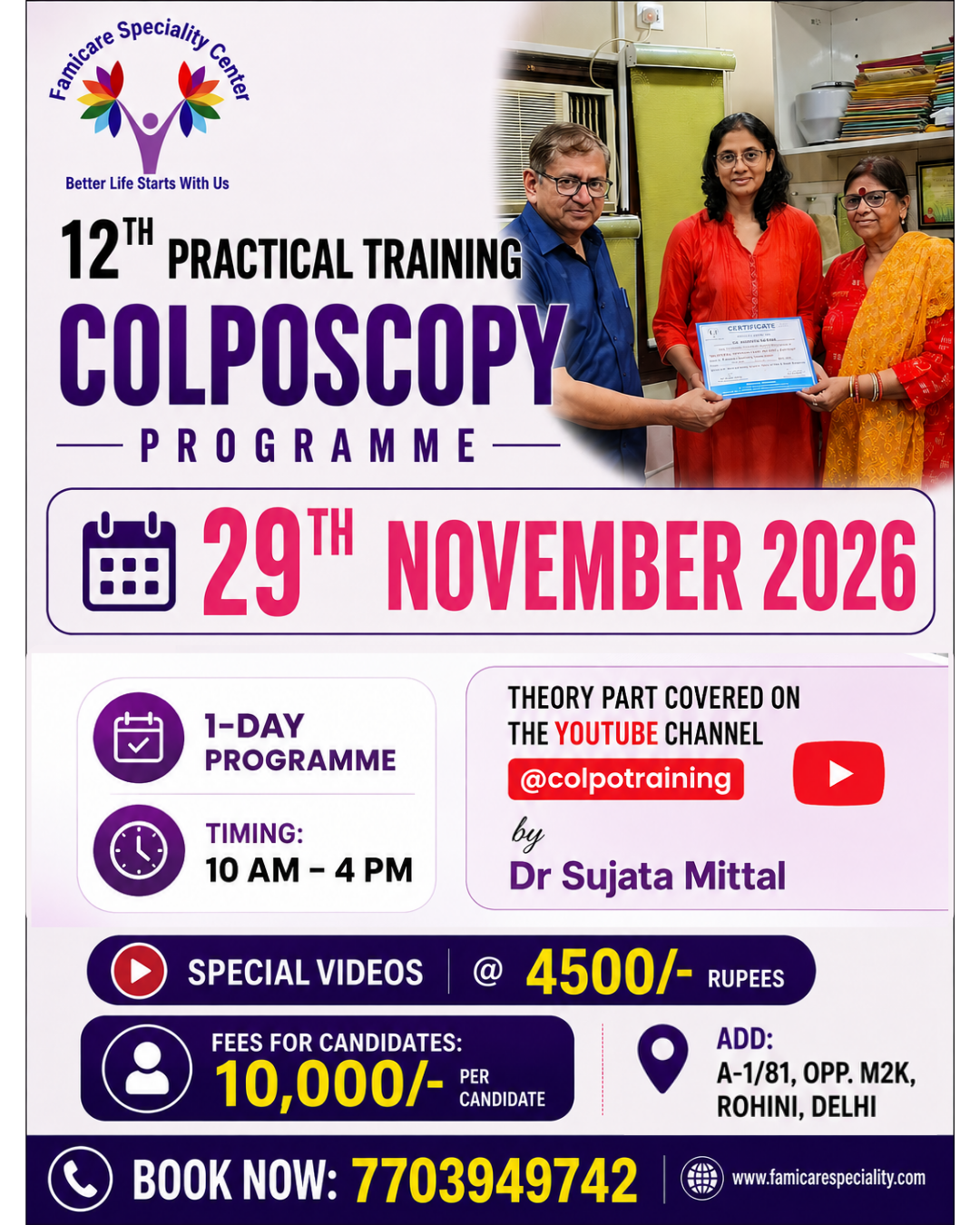 Colposcopy training programme
✨ Practical Colposcopy Training with Hands-On Practical Sessions ✨
 Preventive Oncology
Best Colposcopy in North West Delhi & Rohini: Expert Care at Famicare Speciality Centre
Comprehensive guide to Colposcopy in Rohini & North West Delhi. Learn why expert evaluation is crucial for cervical health and preventive oncology led by Dr. Sujata Mittal.
MASS HYSTERECTOMIES: SLEEPING GOVERNMENT
An investigation first published by India's Business Line in April 2019 exposed HYSTERTOMY TREND in Beed district, Maharashtra: thousands of poor women working as sugarcane cutters…